
Most marketing teams don't have a tools problem. They have a martech gap problem, and it's quietly costing them revenue every day.
You've invested in a CDP, an automation platform, an analytics suite, maybe an AI decisioning engine. The budgets are real. The technology is sophisticated. And yet the results still don't match the investment.
Before you assume it's the platforms, ask yourself one question: how would you actually know? By the end of this post, you'll have a 60-second way to check.
What Is a Martech Gap?
A martech gap is the difference between what your marketing technology stack is built to do and what it can actually deliver, because the behavioral data feeding it is incomplete, delayed, or missing entire audiences. Think of it as a bottleneck upstream of every tool in your stack: the platform isn't broken, but it's working with less than the full picture.
Every platform in your stack is only as good as the data it runs on. When behavioral signals are incomplete, delayed, or missing entire audiences, every downstream system performs below its potential, and revenue slips away without anyone noticing right away.
That's the real story behind most underperforming martech stacks. There are three specific gaps creating it, and they show up in almost every organization to some degree.
Three Common Gaps
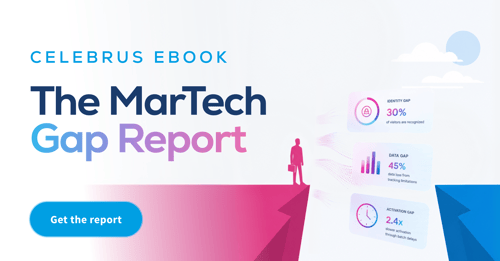
The Identity Gap: You can't market to people you can't see.
Most brands can only recognize roughly 1 in 3 digital visitors. The rest are invisible to tools, models, and campaigns, even when they're actively showing purchase intent. Cookie-dependent identity resolution assumes a visitor becomes "real" at login. Everything before that moment is either incomplete or lost.
The Data Gap: Your analytics tell a story, just not the complete one.
Dashboards look complete. They aren't. As third-party cookies erode and consent frameworks tighten, traditional analytics tools lose visibility into a growing share of visitor behavior. The result: miscredited channels, audiences built from partial signals, and AI models trained on gaps that get amplified at scale.
The Activation Gap: Your platforms are ready, your data isn't fast enough.
Modern martech is built for real-time personalization and in-session decisioning. But when behavioral data still moves in batches, the profile updates or the trigger fires after the customer has already moved on. Conversion windows are short. Most automation acts after they close.
What the Martech Gap Looks Like in Practice
- Financial services (Data Gap): A retail bank cuts spend on channels appearing to underperform in analytics, then discovers those channels were actually reaching visitors their measurement tools couldn't see
- Gaming and hospitality (Identity Gap): A loyalty-driven brand recognizes only 30% of digital visitors, missing even returning customers browsing while logged out
- Insurance (Activation Gap): An insurer's quote-abandonment follow-up happens the next day, by which point most prospects have already chosen a competitor
Different industries, different symptoms, same root cause: a martech gap nobody flagged until the revenue was already gone.
What Closing the Martech Gap Looks Like
Closing each gap comes down to a structural change in how first-party behavioral data is captured and used, not a new layer bolted onto the stack:
- Identity resolved continuously: A persistent profile builds from the first interaction onward, connecting anonymous, previously authenticated, and logged-in behavior instead of waiting for a login to make a visitor visible
- Behavioral signals captured completely: Every session, click, and interaction is captured at the source, so attribution and AI models are working from the full picture instead of whatever a cookie happened to catch
- Data activated in real time: Profiles update continuously and reach downstream systems in milliseconds, so personalization and outreach happen while intent is still active
Results: What Changes When the MarTech Gap Closes
When identity, data, and activation gaps close, the impact shows up fast:
- Bigger addressable audience: Anonymous, high-intent visitors become part of segmentation and personalization, not just an analytics footnote
- More accurate attribution: Budget gets allocated to what's actually converting, not what your tools happened to see
- Faster action: Personalization and outreach happen while intent is still live, not after the moment has passed
The report includes real-world results across gaming and hospitality, financial services, insurance, and ecommerce, including visitor recognition jumping from 30% to 80%+ in eight weeks, and a 250% uplift in conversion when follow-up moved from next-day to real-time.
Take the Quiz: Find Out Where Your Gaps Are
The MarTech Gap Report breaks down each of these three gaps in detail, with the revenue math behind each one and what closing them actually looks like.
Start with the quiz. It takes 60 seconds and tells you exactly where your stack is likely leaking revenue right now.
Get the full report now.